Thin Layer Chromatography and Its types
Thin Layer Chromatography
Thin Layer Chromatography
Thin-layer chromatography is one of the most widely used separation methods. It is a physicochemical separation method, in which the components to be separated are distributed between two phases (Stationary Phase and Mobile phase).
- Ion exchange
- Partition
- Adsorption
- Molecular exclusion
| Type of TLC | Basic Mechanism | Stationary Phase Material |
|---|---|---|
| Adsorption TLC | Adsorption on Stationary Phase | Silica or Alumina |
| Molecular exclusion TLC | Size based separation | Sephadex |
| Ion exchange TLC | Ionic Interaction | Ion Exchange Resin |
| Partition TLC | Affinity to Stationary phase | cellulose like coating substance |
Adsorption chromatography:
Silica gel is a polar stationary phase because it has many polar –OH groups. When this polar stationary phase is paired with non-polar solvent (mobile phase), it separated the sample molecules according to their affinity towards these two phases based on their polarity.
The glasses are coated with adsorbent with different techniques like:
1. Pouring,
2. Dipping,
3. Spraying,
4. Spreading techniques.
In pouring technique, the prepared slurry is poured onto the glass plate and try to maintain an equal level surface.
In the spray technique adsorbent is sprayed on glass plate using a machine sprayer. The best applying technique is spreading technique in which the slurry is kept in the TLC spreader box and sprayed over glass plate.
Sample can be applied by micro pipette or capillary tube. It should be spotted at least 2 cm above the base of or on such height that spotted area should not immersed in mobile phase. The area of the spotted sample should be minimum with sufficient concentration. Mobile phase and TLC plate should be kept in the development chamber and allowed to run solvent system upwards on the TLC plate. Test sample migrate with the solvent system and gets separated into its components (if present) according to its affinity, which can be further visualized by using suitable detecting agent or by placing the developed late under UV light.
Suppose test sample has both types of components, polar as well as nonpolar. When the spots applied at the base point of silica stationary phase, polar compounds stick strongly to silica (because silica is also polar material), whereas nonpolar compounds stick weakly.
When the non-polar solvent system (mobile phase) moves upwards in the stationary phase, nonpolar compounds travel farther with the solvent system with high Rf value, because non-polar compounds have better affinity to non-polar solvents and low affinity for the silica (like dissolves like).
Rf value is calculated by the formula:
Adsorption chromatography:
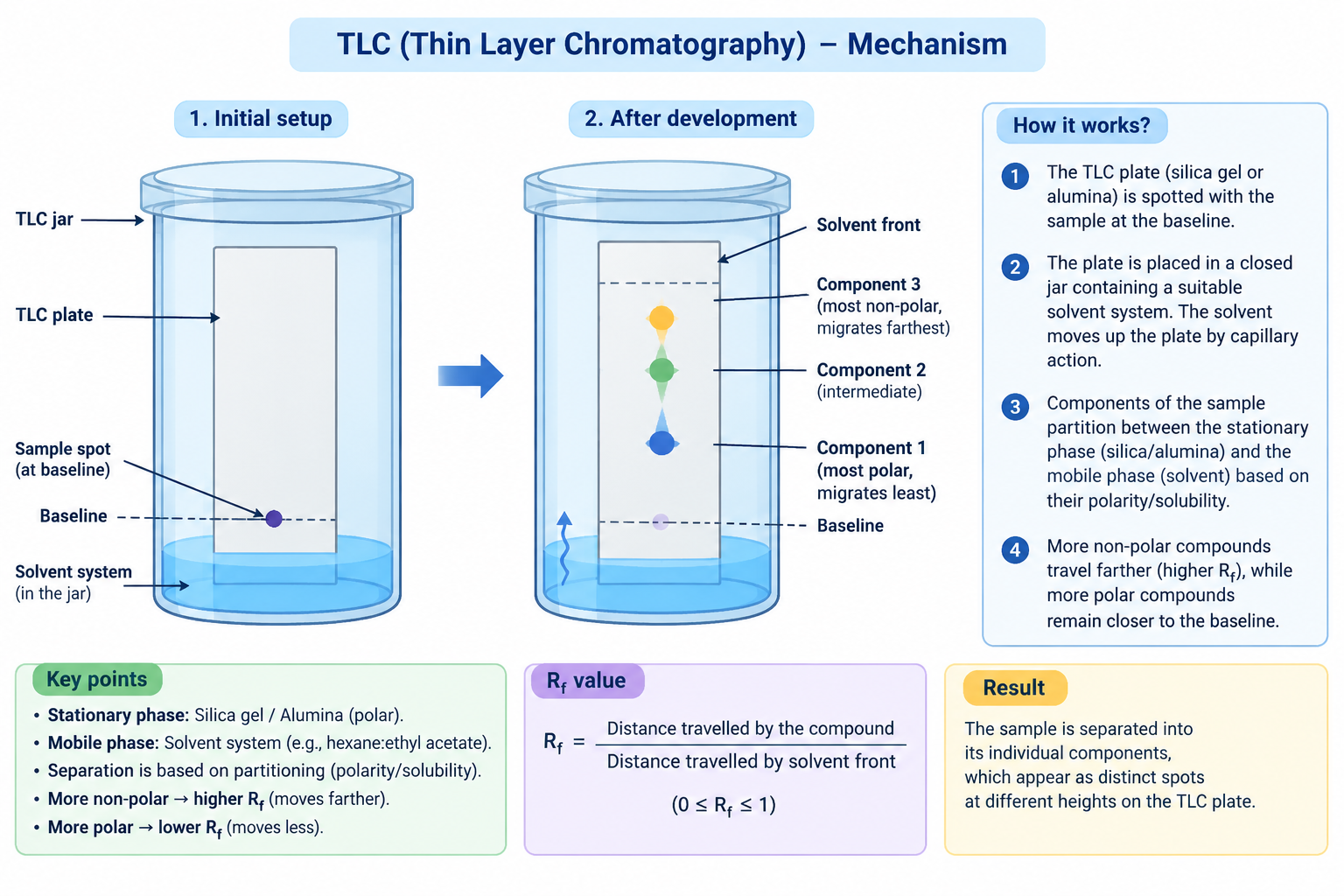
 In the same condition, polar compounds travel slowly to the less distance, because they have high affinity to silica and less affinity to nonpolar solvents with low Rf value.
This type is called adsorption TLC because sample molecules are adsorbed on the surface of silica particles.
- Polar molecules form stronger interactions with silica → stronger adsorption → move slowly (low Rf).
- Non-polar molecules have weaker interactions with silica → weaker adsorption → move more readily with the mobile phase (high Rf).
Partition chromatography:
Partition TLC separates compounds based on their distribution between a stationary phase and a mobile phase according to their relative solubility in the two phases. Compounds which are more soluble in the mobile phase move farther, while those which has more affinity to the stationary phase move less.
In this TLC, cellulose is used as stationary phase. Dry cellulose is never completely dry under normal laboratory conditions. It is highly hydrophilic (water-loving) and naturally absorbs moisture from the atmosphere. This tightly bound water is called bound water or immobilized water.
The mobile phase (organic solvent or solvent mixture) moves over this water containing cellulose stationary phase layer, and the sample distributes itself between the Stationary phase having water bound to cellulose and organic mobile phase or developing solvent.
This immobilized water with cellulose acts as the stationary phase and can hold polar compounds with high affinity. Polar compounds preferentially partition into this more polar cellulose phase and therefore migrate less, whereas less polar compounds with greater affinity for the mobile phase migrate farther. Polar and non-polar compounds differ in their affinity for the stationary and mobile phases because of differences in polarity.
In this way sample molecules distribute themselves between two phases rather than being retained mainly by adsorption onto a solid surface.
Partition chromatography:
Ion-exchange chromatography:
In Ion-Exchange TLC, the stationary phase is prepared by coating the plate with an ion-exchange material containing charged functional groups, examples
Ion-exchange chromatography:
- DEAE-cellulose (Diethylaminoethyl cellulose) – an anion exchanger.
- CM-cellulose (Carboxymethyl cellulose) – a cation exchanger.
- Dowex resins – synthetic ion-exchange resins.
- Amberlite resins – synthetic ion-exchange materials.
- Ion-exchange-modified silica gel – silica containing charged functional groups.
- Oppositely charged ions are attracted to the stationary phase.
- Ions with stronger interactions are retained longer and travel less.
- Ions with weaker interactions move faster with the mobile phase.
Molecular exclusion (Gel filtration) TLC:
This technique is also termed as gel-permeation, gel-exclusion, size- exclusion, and molecular- sieve chromatography.
This chromatography separates molecules on the basis of their molecular size and shape using a stationary phase containing porous gel particles, such as Sephadex or agarose.
In gel filtration chromatography, the stationary phase consists of porous gel beads containing liquid-filled pores. The liquid present between the beads is called the void volume, while the liquid inside the pores forms the internal volume.
Large molecules cannot enter the pores and therefore travel through wider gaps between beads faster. Whereas the small molecules have a tendency to diffuse into the interior of porous particles, which restricts their flow, whereas large molecules are unable to enter the pores and have a tendency to flow freely.
Thus, separation occurs according to molecular size, with larger molecules eluting faster smaller molecules elute slower.
This technique is used for the separation, purification, and molecular weight estimation of proteins, polysaccharides, and other biomolecules.
Molecular exclusion (Gel filtration) TLC:
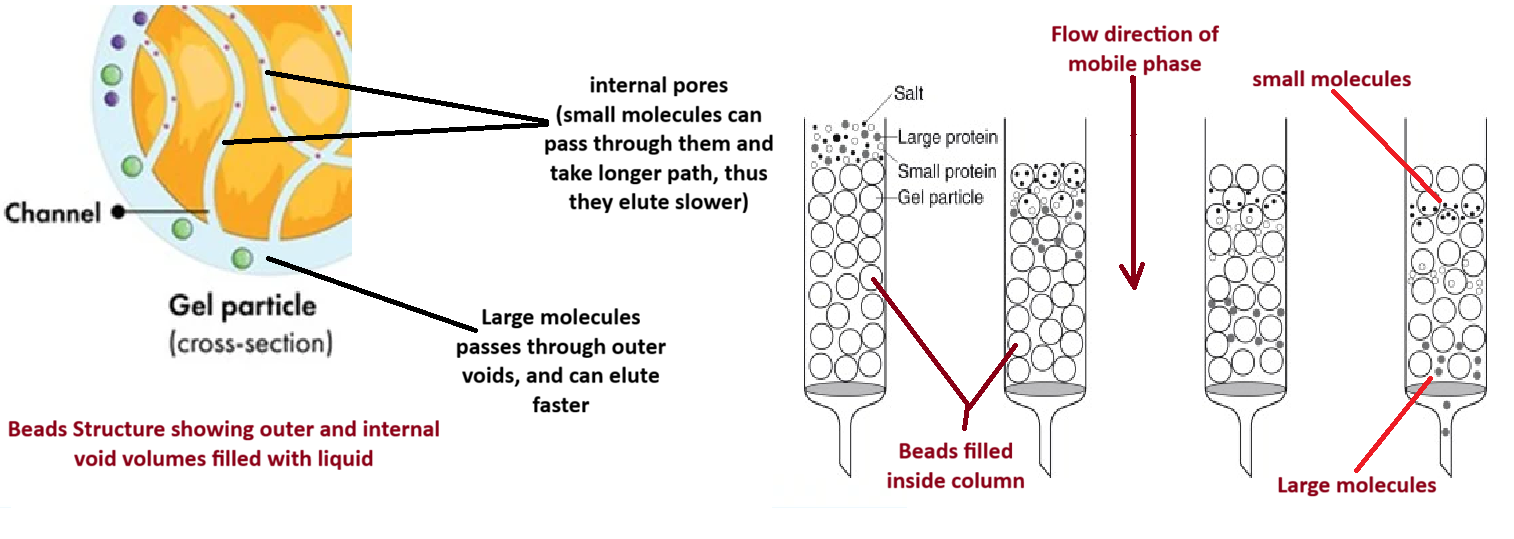 In this method, the test sample must be diluted in appropriate organic solvents (mobile phase). and run it through the column.
Stationary Phase: Microporous gel beads are arranged in a column, which serves as the stationary phase. Gel filtration chromatography frequently uses cross-linked polyacrylamide, agarose gel, and hydroxypropylated Sephadex as support materials.
The molecules which are sensitive to changes in pH, temperature, metal ion concentration, etc. can be separated via gel filtration, nucleic acid, nucleotide, proteins and peptides from various sources have been successfully purified using gel-filtration chromatography.