Application and Role of Spectroscopy in Isolation Purification and Identification of Crude Drugs
Introduction to Spectroscopy
Introduction to Spectroscopy
Spectroscopy is the study of how matter interacts with the electromagnetic radiation.
By analysing the absorption, emission, or scattering of light across various wavelengths, spectroscopy reveals detailed information about the composition, structure, and properties of materials.This technique is very significantly in scientific research, quality control, and identification and structure analysis of different natural and synthetic chemicals.
- When a medicinal plant is analysed, the phytochemicals are first extracted and isolated. Simple chemical tests are then performed to identify the class of phytochemical, such as alkaloids, flavonoids, tannins, glycosides etc.
- After confirming its presence, quantitative analysis is carried out to determine how much of the phytochemical is present in the plant.
- The plant may also be analyzed for trace elements and heavy metals. If a pure compound has been isolated, spectroscopic techniques are used to check its purity. If impurities are detected, the isolation and purification methods are improved until a pure compound is obtained.
- Finally, advanced spectroscopic techniques are used to determine the complete molecular structure of the purified compound. This structural information is essential for identifying new compounds, understanding their pharmacological properties, and supporting further chemical and pharmaceutical research.
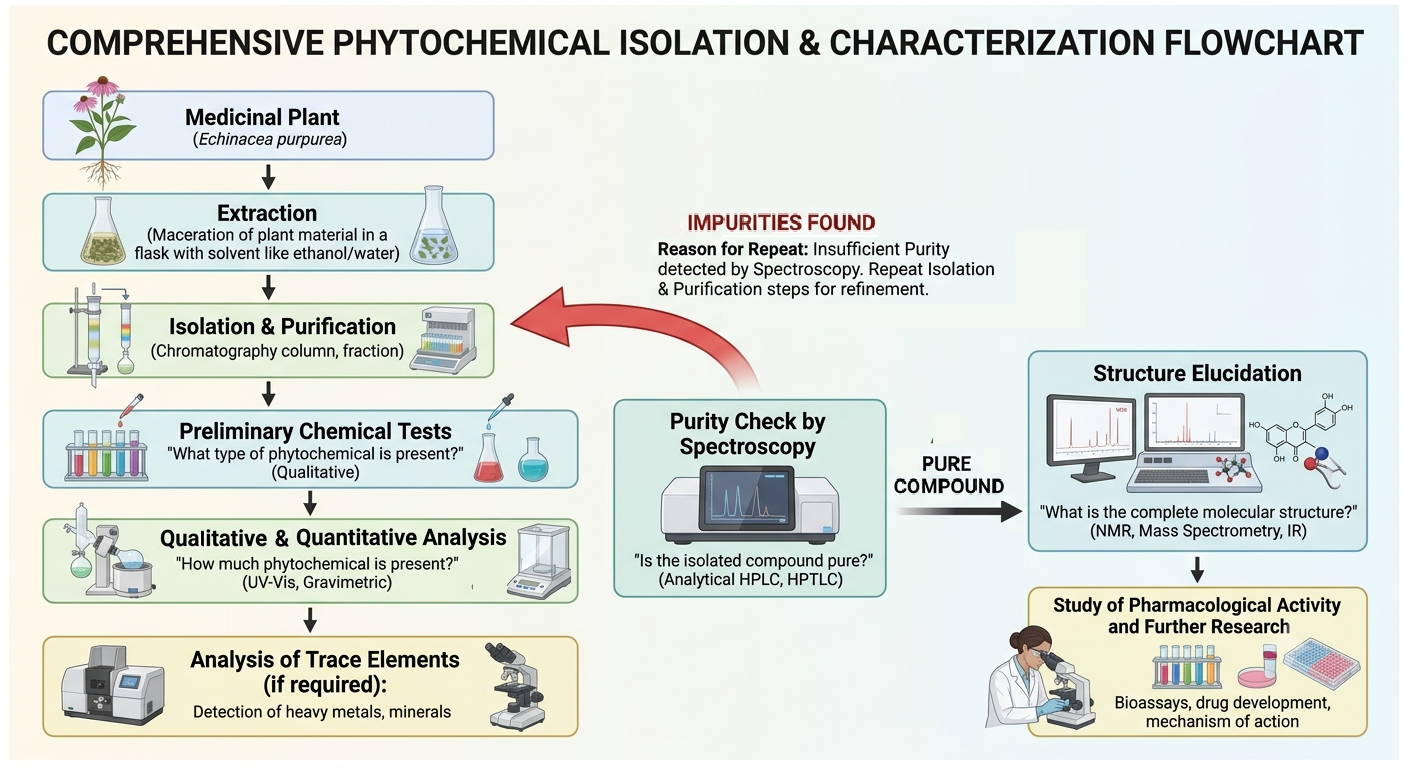
Stepwise Process of Phytochemical Analysis
Stepwise Process of Phytochemical Analysis
1. Extraction and Isolation
This is for obtaining the phytochemical in pure form because plants contain hundreds of different chemical constituents. Therefore, the first step is to extract the phytochemicals from the plant material using suitable solvents and then isolate the desired compound from this complex mixture through purification by the applications of varios chromatographic techniques.
2. Qualitative Identification
Once the compound has been isolated, the next step is to determine which phytochemical is present, this is called the qualitative estimation. Various spectroscopic techniques help by providing characteristic information about the compound.
- UV-Visible Spectroscopy
- FTIR Spectroscopy
- Mass Spectrometry
- NMR Spectroscopy
3. Quantitative Estimation
After identifying the phytochemical, its concentration or amount in the plant sample is determined. So, the main purpose is to measure the quantity of the identified phytochemical. Techniques commonly used for this are:
- UV-Visible Spectrophotometry
- HPLC
- HPTLC
- GC
4. Structure Elucidation
Even after identifying the compound, scientists need to determine its complete molecular structure, including the arrangement of atoms, functional groups, and stereochemistry. Spectroscopic techniques commonly used for this were:.
- FTIR
- Mass Spectrometry
- 1H and 13C NMR
- UV Spectroscopy
Applications of Different Spectroscopic Techniques
Applications of Different Spectroscopic Techniques
| Purpose | Suitable Technique |
|---|---|
| Identification of Phytochemicals | UV-Visible, FTIR, NMR, Mass Spectrometry |
| Quantitative Estimation of Phytochemicals | UV-Visible Spectroscopy, HPLC, HPTLC, Gas Chromatography |
| Structure Elucidation | FTIR, NMR, Mass Spectrometry |
| Trace & Heavy Metal Analysis | Atomic Fluorescence Spectroscopy (AFS), Atomic Absorption Spectroscopy (AAS), Maas Spectroscopy |
Atomic and Molecular level Spectroscopy for Phytochemical Analysis
Atomic and Molecular level Spectroscopy for Phytochemical Analysis
Atomic Level Spectroscopic Methods
| Technique | Application |
|---|---|
| Atomic Absorption Spectroscopy (AAS) | Used to detect and quantify metal elements present in plant materials or herbal formulations |
| Atomic Fluorescence Spectroscopy (AFS) | Used for the determination of trace and heavy metals present in medicinal plants |
| X-ray spectroscopy | Used to determine elemental composition of any compound, electronic environment around atoms, crystal structure analysis etc.y |
| Atomic Mass spectroscopy | In identification and quantitative analysis of elements, Gives information about molecular structure, functional groups, bonding, and molecular weight |
Molecular Level Spectroscopic Methods
| Technique | Application |
|---|---|
| UV-Visible Spectroscopy | To determine presence of chromophores (light-absorbing groups), qualitative and quantitative analysis of any compound based on absorption maxima (λmax). |
| Infrared spectroscopy (FTIR) | To identify the presence of functional groups in any compound or molecule. |
| Nuclear Magnetic Resonance (NMR Spectroscopy) | To identify carbon structural backbone and positioning of hydrogen bonds in any compound. |
| Mass Spectrometry | To determine the molecular structure and isotopes |