Industrial production, Estimation and Utilization of Digoxin and Diosgenin
DIGOXIN
DIGOXIN
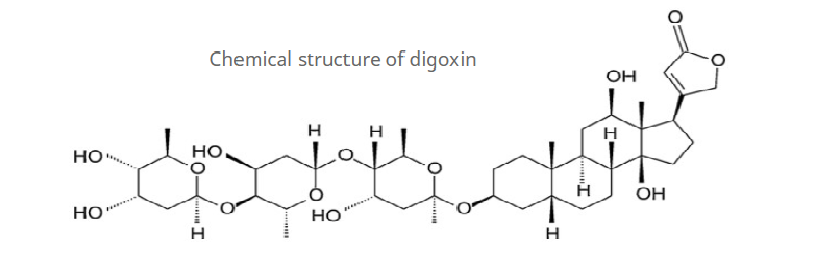
Digoxin is a cardenolide-type cardiac glycoside obtained mainly from the leaves of Digitalis lanata. It consists of a steroidal aglycone (digoxigenin) linked to three molecules of the sugar digitoxose through a glycosidic bond. The molecule also contains an unsaturated five-membered lactone ring at the C-17 position, which is essential for its cardiotonic activity.
Biological Sources:
Biological Sources:
Digoxin or Lanoxin is the most widely used cardiac glycoside obtained from the leaves of Digitalis lanata; family Scrophulariaceae. Lanatosides are the naturally occurring primary glycosides of D. lanata which includes Lanatoside A, lanatoside B and lanatoside C.
Digoxin is a secondary glycoside which is produced from a primary glycoside Lanatoside C.Industrial Production:
Industrial Production:
Digoxin is obtained commercially from the fresh leaves of Digilatis lanata.
Lanatoside A, B and C were used as the starting material for the commercial production of digoxin. Lanatosides are larger natural molecules found in Digitalis lanata. By removing acetyl group with mild alkali treatment and glucose molecule with controlled enzymes treatment, the lanatosides were converted into the active drugs digitoxin, gitoxin, and digoxin.- The leaves are first defatted with benzene prior to extraction to get better yield of the glycosides.
- To extract lanatosides, fresh leaves of Digitalis lanata are crushed and ground with neutral salt to inactivate the enzymes, as the leaves contains natural plant enzymes can break down lanatosides uncontrollably. If this happens, some of the valuable lanatosides will be lost. So, this step protects the lanatosides from being hydrolyzed by plants own enzymes during extraction.
- After that the pulp is further extracted with ethyl acetate and intentionally hydrolyzed with some enzymes under controlled conditions.
- The ethyl acetate extract is concentrated, dried and further subjected to chromatographic purification to yield lanatoside A (46%), lanatoside B (17%) and lanatoside C (37%). The fractions obtained are crystallized from alcohol.
- Lanatoside C after subsequent hydrolysis converted into digoxin.
Identification test for Digoxin:
Identification test for Digoxin:
Melting point: 230–265°C
Chemical test:- Digoxin is dissolved and diluted in hot methanol. The aliquot of the solution is evaporated to dryness. acidified ferric chloride Test Solution is added to the residue. A green colour develops that slowly changes to a deep green blue colour.
- This test is used to detect the presence of deoxy sugar (digitoxose) in digoxin. When digoxin is treated with glacial acetic acid containing ferric chloride followed by concentrated sulphuric acid, a brown ring at the junction of two layers and a bluish-green colour in the upper layer are observed.
Estimation by Thin Layer Chromatography:
Estimation by Thin Layer Chromatography:
Dissolve about 1 mg of the glycoside in 1 ml of alcohol. The sample is spotted over silica gel-G plates and eluted with cyclohexane-acetone-acetic acid (49:49:2). Dried TLC plates are sprayed with 50% aqueous sulphuric acid.
Digoxin appears as a blue spot under 385 nm UV light.Utilization of Digoxin:
Utilization of Digoxin:
Digoxin is widely used in the treatment of heart diseases. It is primarily prescribed for the management of congestive heart failure (CHF) and atrial fibrillation.
It increases the force of heart muscle contraction while slowing the heart rate, thereby improving cardiac efficiency. Digoxin helps relieve symptoms such as fatigue, shortness of breath, and swelling associated with heart failure.DIOSGENIN
DIOSGENIN
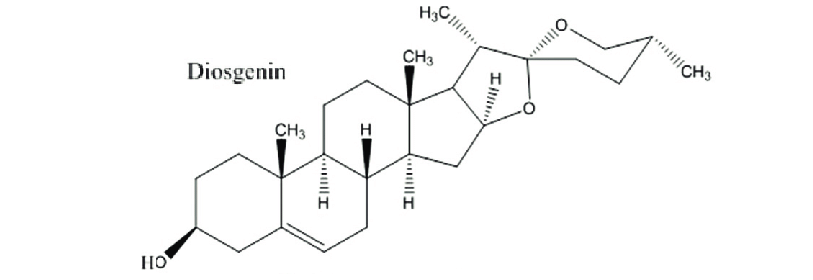
Diosgenin is a steroid sapogenin found in fenugreek seeds and yam.It has the molecular formula C₂₇H₄₂O₃ and contains a spiroketal side chain with a hydroxyl (-OH) group at the C-3 position. Diosgenin serves as an important precursor for the commercial synthesis of steroidal drugs such as corticosteroids, progesterone, and other steroid hormones.
Biological Sources:
Biological Sources:
It is obtained from the dried tubers of Dioscorea deltoidea, Dioscorea wallichii and other species of Dioscorea (Dioscoreaceae).
Industrial Production and Isolation Process:
Industrial Production and Isolation Process:
Commercially Diosgenin can be produced bu several methods, a brief of these methods is given below:
Alcoholic extraction method- The diosgenin tubers are cut into small pieces and dried
under sun. The dried tubers are ground into a powder and extracted twice for six to eight hours using either ethanol or methanol. After filteration, the filtrate is condensed into a syrupy liquid. After that, the concentrated liquid is hydrolyzed for two to twelve hours using either sulfuric acid or hydrochloric acid. Approximately 85% of the crude diosgenin precipitates. Alcohol is used to purify the precipitates after they have been filtered and cleaned with water.
- The dried tubers are ground into a powder with a 100–200 mesh size. After that, it is either refluxed or heated for two to six hours in an autoclave with 2-4 N mineral acid. After filtering, the crude hydrolyte is cleaned with water until it becomes neutral. Dried and extracted again for 6 h with hydrocarbon solvent. The liquid is concentrated to about 25 ml. It is allowed to stand for some time in a refrigerator for 1 h. The crystals of diosgenin are filtered out and then it’s washed with acetone.
- In a hammer mill, the fresh green roots are gathered and crushed. The mesh is put in the fermentation bin and let two days to ferment. To lower the moisture level to 7–8%, the fermented mesh is sun-dried. After that, it is hydrolyzed at a lower temperature using a mineral acid. The resulting solution is extracted with heptane to obtain diosgenin.
- The fresh roots are homogenized with equal weight of
water, concentrated acid is added until the required strength is obtained and then it is extracted with hydrocarbon solvent to obtain diosgenin.
The hydrolysed liquid is concentrated and extracted with hydrocarbon
solvent to obtain diosgenin.
Estimation by Thin Layer Chromatography:
Estimation by Thin Layer Chromatography:
The sample dissolved in methanol is spotted in Silica gel plates and developed in Toluene: ethyl acetate (7:3). Dark green spot (Rf- 0.37) of diosgenin will appear when the dried plate is sprayed with anisaldehyde-sulphuric acid reagent.
Utilization of Diosgenin:
Utilization of Diosgenin:
It is widely used as a starting material for the industrial production of steroidal drugs such as corticosteroids, progesterone, testosterone, and other sex hormones.
Diosgenin is also utilized in the synthesis of anti-inflammatory and contraceptive medications. In addition, it has attracted research interest due to its potential antioxidant, anticancer, antidiabetic, and cholesterol-lowering properties.