Industrial production, estimation and utilization of Atropine and Caffeine
ATROPINE
ATROPINE
Biological Sources:
Biological Sources:
It’s a tropane alkaloid, obtained from dried leaves and flowering tops of Atropa belladonna, Family- Solanaceae. Other plant sources include Datura stramonium & Hyoscyamus niger. Hyoscyamus muticus is the preferred plant for large scale production because it contains a high amount of alkaloids. Datura stramonium is also commonly used.
Atropine is an optically inactive laevorotatory isomer of hyoscyamine.Industrial Production:
Industrial Production:
The industrial production of atropine can be achieved in several steps:
(1) Selection of Plant material and Extraction:- The powdered drug material is thoroughly moistened with an aqueous solution of sodium carbonate and then extracted with ether or benzene.
- The alkaloidal bases are extracted from the solvent with water acidified with acetic acid.
- The acid solution is then shaken with solvent ether to remove colouring matter.
- The alkaloids are precipitated with sodium carbonate, filtered off, washed and dried. The dried mass is dissolved in solvent ether or acetone and dehydrated with anhydrous sodium sulphate before filtration. The filtrate after concentration and cooling yields crude crystals of hyoscyamine and atropine from the solution.
- The crude crystalline mass is separated from the solution. The crude crystalline mass obtained after filtration is dissolved in alcohol, and sodium hydroxide solution is added and the mixture is allowed to stand until hyoscyamine is completely racemized to atropine which is indicated by the absence of optical activity.
- The crude atropine is purified by crystallization from acetone.
Identification test for Atropine (Vitali–Marin reaction):
Identification test for Atropine (Vitali–Marin reaction):
Dilute solution of atropine, when treated with concentrated nitric acid and the mixture evaporated to dryness on the steam bath, produces a pale yellow residue. When a drop of freshly prepared solution of potassium hydroxide is added to the residue, it gives a violet colouration.
Melting point: 115–116°CEstimation by Thin Layer Chromatography:
Estimation by Thin Layer Chromatography:
One percentage solution of atropine dissolved in 2 N acetic acid is spotted over silica gel-G plate and eluted in the solvent system of strong ammonia solution; methanol (1.5:100). TLC plate is spread with an acidified iodoplatinate solution. Atropine gives the Rf value 0.18.
Likewise atropine sulphate shows the Rf value 0.70, in the solvent system acetone : 0.5 M sodium chloride and spraying with Dragendorff’s reagent.Utilization of Atropine:
Utilization of Atropine:
Atropine is an important tropane alkaloid widely used in medicine. It is used to dilate the pupil during eye examinations, to treat bradycardia (slow heart rate), and as an antidote for organophosphate and nerve agent poisoning.
It also reduces salivary and bronchial secretions before surgery and helps relieve gastrointestinal and urinary tract spasms.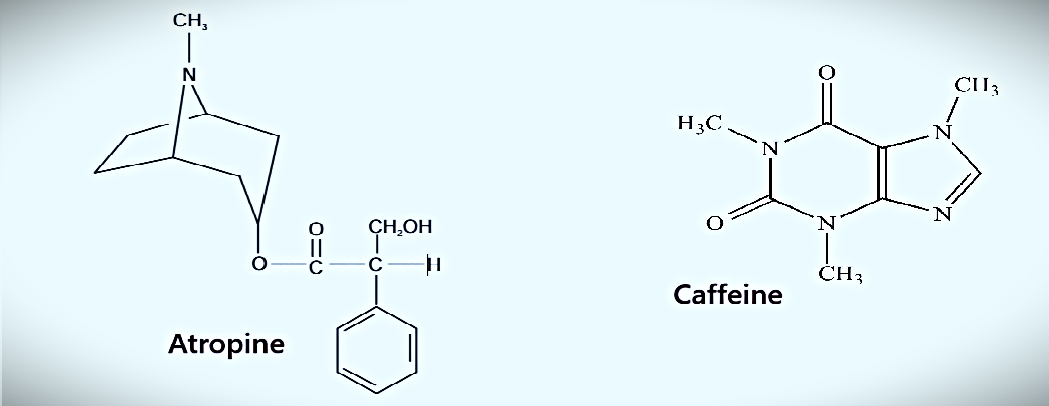
CAFFEINE
CAFFEINE
Caffeine or 1,3,7- trimethylxanthin is a purine base present along with other related bases like theophyline and theobromine in coffee, tea, cocoa, guarana, kola and mate. Although caffeine is largely produced synthetically, it is usually isolated from tea leaves or recovered from coffee seeds during decaffeination process.
The primary industrial biological sources of natural caffeine are the dried ripe seeds (beans) of Coffea arabica and Coffea canephora (Robusta), as well as the leaves of the Camellia sinensis (tea) plant. Tea leaves contain 1–4% of caffeine while coffee seeds contains 1–2% of caffeine.Industrial Production:
Industrial Production:
Various methods were used for the isolation of caffeine from different sources. Some important processes are described below:
Method 1:- The coarse powder of tea leaves is extracted with boiling water and the aqueous extract is filtered while hot. The warm extract is treated with lead acetate to precipitate tannins and filtered. The excess of lead acetate present in the solution is precipitated as lead sulphate with dilute sulphuric acid. The filtered solution is boiled with charcoal to remove colouring matter if any, and filtered to remove charcoal. The filtered decolourized solution is extracted with chloroform. The combined chloroform extract after evaporation affords caffeine as a white material. It is re-crystallized with alcohol.
Method 2:
Finely or coarsely powdered tea leaves are extracted with ethanol in soxhlet extractor. The caffeine so extracted in ethanol is then adsorbed on magnesium oxide. Caffeine is then disorbed after treatment with 10% H2SO4 . It is then extracted with chloroform and re-crystallized.
Method 3:
Caffeine is extracted from coffee beans by the process of leaching with water. The highest yield up to about 90% was obtained when the coarse coffee powder is extracted with water at 75°C. The extraction takes about half an hour with water/coffee ratio of 9:1.
Method 4 (Super-critical fluid extraction):
Decaffeination of coffee using super-critical fluid extraction. Super-critical fluid extraction has been efficiently used for the decaffeination of coffee. The super-critical medium in a pressure vessel is circulated through moist coffee where it becomes charged with caffeine. It is then passed through second pressurized vessel containing an adsorbing medium such as activated carbon, resin or water which retains caffeine. Adsorbed caffeine is then separated by extraction with chloroform.
Identification test:
Identification test:
Melting point: 235–237°C
Chemical test (Murexide test)- Dissolve a small amount of caffeine in a few drops of nitric acid.
- Evaporate the solution to dryness.
- Add a few drops of ammonia solution.
- A purple/violet colour appears, indicating the presence of caffeine.
Estimation by Thin Layer Chromatography:
Estimation by Thin Layer Chromatography:
Dissolve 1 mg of caffeine in 1 ml of chloroform or methanol. Spot the sample on TLC plate and elute it in ethyl acetate–methanol–acetic acid (80:10:10). Visualize the dried TLC plate by exposure to iodine vapour. Caffeine develops a spot at Rf value 0.41.
Utilization of Caffeine:
Utilization of Caffeine:
Caffeine is a natural xanthine alkaloid widely used as a central nervous system (CNS) stimulant. It helps reduce fatigue, increase alertness, and improve concentration. It is also included in some analgesic and migraine medications to enhance their effect.
In addition, caffeine is used in the treatment of apnea of prematurity in newborn infants and is a common ingredient in beverages such as coffee, tea, and energy drinks.