General Introduction, Composition, Chemistry and Chemical classes, Bio-sources, Therapeutic uses of : Alkaloids: Vinca
Alkaloids
Alkaloids
Introduction
Introduction
Alkaloids (whose name originally comes from "alkali-like") can react with acids and then form salts, just like inorganic alkalis. These nitrogen atoms can behave like a base in acid-base reactions. Alkaloids are basic in nature because of the presence of lone pair of electrons on nitrogen atom.
Alkaloids are a huge group of naturally occurring organic compounds which contain nitrogen atom (amino or amido in some cases) in their structures. These nitrogen atoms cause alkalinity of these compounds. These nitrogen atoms are usually situated in cyclic ring system. For example, indole alkaloids are those that contain nitrogen atom in indole ring system. Alkaloids in their pure form are generally colourless, odourless crystalline solids, and sometime they can be yellowish liquids. Quite often they have bitter taste.
Classification of Alkaloids
Classification of Alkaloids
Generally based on structures, alkaloids can be divided into classes like indoles, quinolines, isoquinolines, pyrrolidines, pyridines, pyrrolizidines, tropanes, and terpenoids and steroids.
Classification of Alkaloids based on the heterocyclic ring system:| Alkaloid Class | Ring System | Example(s) |
|---|---|---|
| Pyridine | Pyridine | Nicotine, Coniine |
| Piperidine | Piperidine | Lobeline, Piperine |
| Pyrrolidine | Pyrrolidine | Hygrine |
| Tropane | Tropane | Atropine, Cocaine |
| Quinoline | Quinoline | Quinine |
| Isoquinoline | Isoquinoline | Morphine, Berberine |
| Indole | Indole | Strychnine, Reserpine |
| Imidazole | Imidazole | Pilocarpine |
| Purine | Purine | Caffeine, Theobromine |
| Quinazoline | Quinazoline | Vasicine |
| Phenanthridine | Phenanthridine | Colchicine |
| Acridine | Acridine | Acronycine |
| Non-heterocyclic | None | Hordenine |
The alkaloids contain one or more number of nitrogen and can exist in some forms of amines, i.e.
| Category of Alkaloid | Description | Examples |
|---|---|---|
| Primary Amines (R-NH₂) |
Contain a nitrogen atom bonded to one carbon group and two hydrogen atoms | Norephedrine |
| Secondary Amines (R₂-NH) |
Contain a nitrogen atom bonded to two carbon groups and one hydrogen atom | Ephedrine |
| Tertiary Amines (R₃-N) |
Contain a nitrogen atom bonded to three carbon groups with no hydrogens attached directly to the nitrogen | Atropine Morphine |
| Quaternary Ammonium Salts (R₄-N⁺) |
Contain a permanently charged nitrogen atom bonded to four carbon groups | Tubocurarine |
Vinca
Vinca
Biological Sources of Vinca Alkaloids
Biological Sources of Vinca Alkaloids
Vinca alkaloids are mainly obtained from Catharanthus roseus (Madagascar periwinkle), belongs to the family – Apocynaceae. This is the primary source of vincristine and vinblastine, along with other indole alkaloids such as ajmalicine, serpentine, and catharanthine.
Composition and Chemistry of Vinca
Composition and Chemistry of Vinca
The bioactive components of Vinca are predominantly indole alkaloids. More than 100 alkaloids have been isolated from different parts of the plant, including the leaves, stems, roots, and flowers.
The two most significant and well-studied alkaloids are vincristine and vinblastine, both of which are used in cancer chemotherapy.Some major and minor alkaloids found in Vinca are: Vincristine, Vinblastine, Vinpocetine, Reserpine, Ajmalicine, Ajmaline, Yohimbine, Vindesine, Catharanthine, Vindolidine, Vindoline, Vindolicine, Catharoseumine, Tabersonine, Catharanthamine, Catharine.
Along with these it also contains carbohydrate, saponins, tannins, flavonoid, steroids, triterpenoid, loganic acid, triterpenoid etc.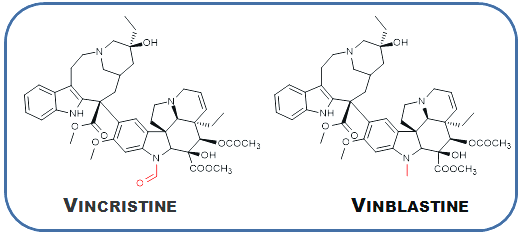
Chemical Classes of Vinca Alkaloids
Chemical Classes of Vinca Alkaloids
The alkaloids derived from Vinca can be categorized into several chemical classes:
Monoterpenoid Indole Alkaloids: The primary active compounds, vincristine and vinblastine, belong to this class. These are dimeric indole alkaloids characterized by complex structures formed by the coupling of two monomeric units. Ajmalicine Alkaloids: These include ajmalicine, also known as raubasine, which has antihypertensive and vasodilatory properties. Ajmalicine is derived from the indole alkaloid pathway. Catharanthine Alkaloids: Catharanthine is another monomeric indole alkaloid found in Vinca that plays a crucial role in the biosynthesis of vincristine and vinblastine. It exhibits various pharmacological properties, including antihypertensive and sedative effects. Flavonoids and Phenolic Compounds: While not as prominent as alkaloids, Vinca also contains several flavonoids and phenolic compounds, such as quercetin and kaempferol. These compounds contribute to the antioxidant and anti-inflammatory activities of the plant.
Therapeutic Uses of Vinca Alkaloids
Therapeutic Uses of Vinca Alkaloids
Vinca alkaloids are well-known for their therapeutic properties, particularly in cancer treatment:
- Cancer Chemotherapy: Vincristine and vinblastine are widely used in chemotherapy regimens for treating various types of cancers, including Hodgkin's lymphoma, non-Hodgkin's lymphoma, leukemia, breast cancer, and lung cancer. They work by inhibiting microtubule formation during cell division, thereby preventing cancer cells from proliferating.
- Antihypertensive and Vasodilatory Effects: Ajmalicine and serpentine, alkaloids derived from Catharanthus roseus, exhibit antihypertensive and vasodilatory effects. They are used in the treatment of hypertension and cerebrovascular disorders.
- Nootropic and Neuroprotective Effects: Vincamine, an alkaloid from Vinca, is utilized for its vasodilatory effects on cerebral blood vessels, enhancing blood flow to the brain. It is employed in the treatment of cognitive disorders, memory loss, and vertigo.
- Antimicrobial and Antidiabetic Effects: Various Vinca alkaloids have shown antimicrobial activities against bacteria, fungi, and viruses. In addition, some studies suggest their potential role in managing diabetes by modulating glucose metabolism.
| Alkaloid | Therapeutic Uses |
|---|---|
| Vincristine, Vinblastine | Hodgkin’s and Non-Hodgkins lymphoma, Leukamia, Breast cancer, Lung Cancer, testicular cancer, Wilms’ tumour |
| Ajmalicine, Serpentine | Antihypertensive and Vasodilatory effect used in cerebrovascular disorders |
| Vincamine | Enhancing blood flow in the brain and used in cognitive disorders, memory loss and vertigo. |
| Vinorelbine, Vindesine | Lung and Ovarian cancer |
| Vinburnine | Improving cerebral and coronary circulation, used in conditions like coronary artery diseases and peripheral artery diseases. |
| Other minor alkaloids | Used as antimicrobial, Anti-inflammatory, Anti-bacterial and Anti-fungal actions. |