Pharmaceutical Dosage Forms
What is Dosage Form ?
A dosage form is the physical form in which a drug product is presented, combining the active pharmaceutical ingredients (APIs) and inactive components (excipients) in a specific configuration for administration to the body.
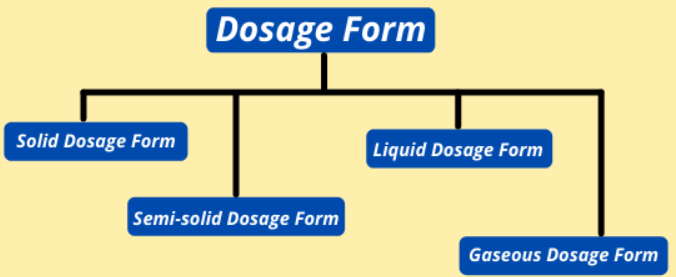
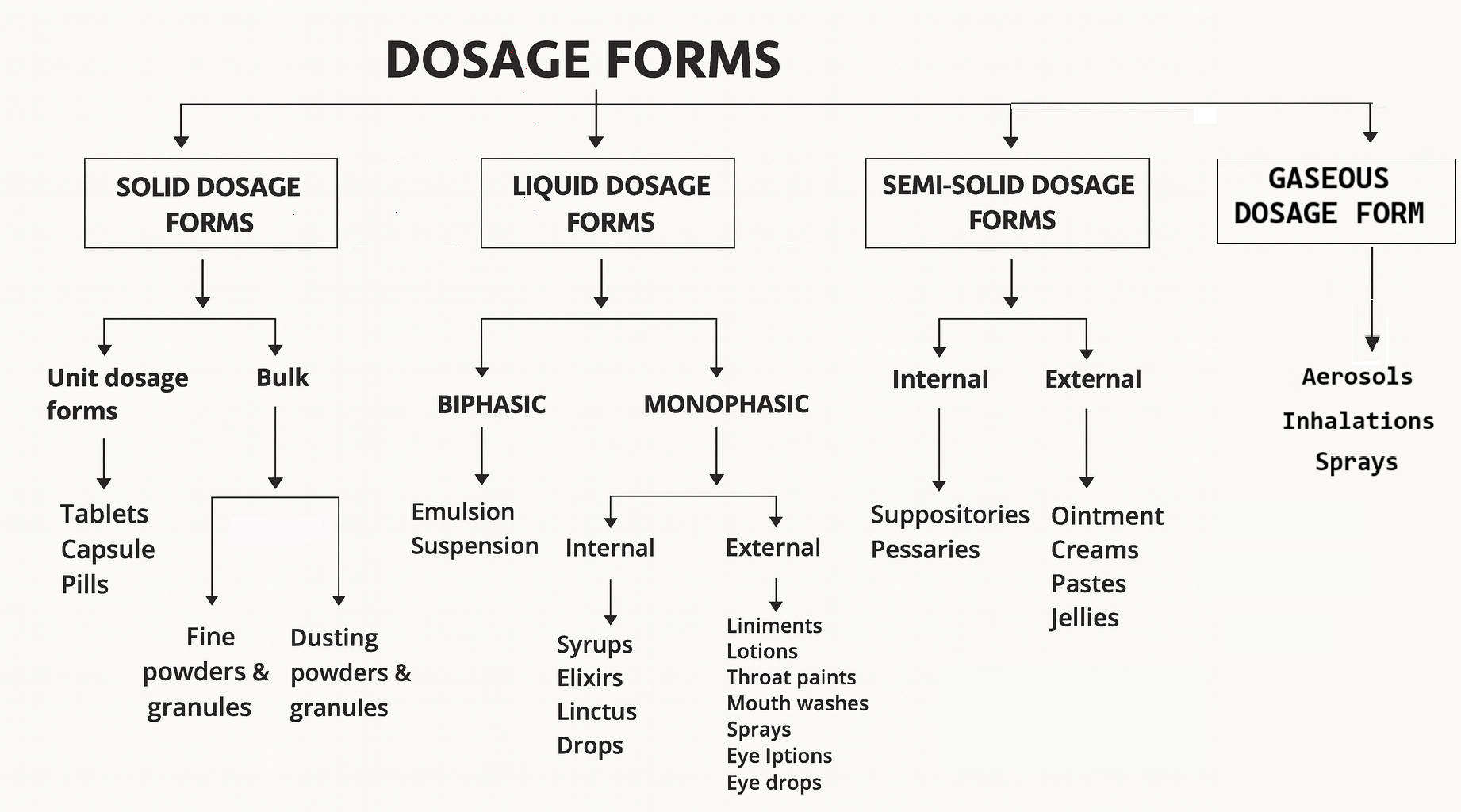
Solid Dosage Form
Solid dosage forms are one type of dosage form, It's solid in nature and contains one or more drugs for therapeutic effects and excipients like binding agents, sweetening agents, coloring agents, etc.
Example of solid dosage form:Tablets, capsules, granules, sachets, powders, powder for inhalation, etc.
Liquid Dosage Form:
The liquid form of a drug dose for administration or consumption. The route of administration may be oral, intravenous, intramuscular, cutaneous, subcutaneous, etc.
Examples of liquid dosage forms: Syrup, mixture, linctuses, elixirs, parenteral preparations, etc.
Gaseous Dosage Form:
Gaseous dosage forms are gas in nature. In the form of gas, therapeutically active medicaments are present in it. It may be applied for internal as well as external purposes like skin, nose, mouth, etc.
Examples of semi-solid dosage forms: Sprays, vaporizers, Aerosols, nebulizers, Inhalers, etc.
Semisolid Dosage Forms:
Semisolid dosage forms are drug products with a consistency between a solid and a liquid that are primarily intended for topical application to the skin or mucous membranes (e.g., eye, nasal, rectal, or vaginal tissues).
Examples are ointments, creams, gels etc.
Tablets
Tablets are solid, unit-dose pharmaceutical dosage forms, prepared by compressing or molding powders or granules containing one or more active pharmaceutical ingredients (APIs) along with suitable excipients.
Tablets generally have a firm, compact consistency and may vary in shape, size, color, and surface finish depending on their intended use and formulation design. They can be formulated for immediate release, modified release (such as sustained, controlled, or delayed release), or for special purposes like chewable, effervescent, dispersible, and sublingual tablets.
Tablets are primarily used for systemic drug delivery via the gastrointestinal tract, though some types (e.g., buccal and sublingual tablets) provide rapid absorption through the oral mucosa.
Capsules
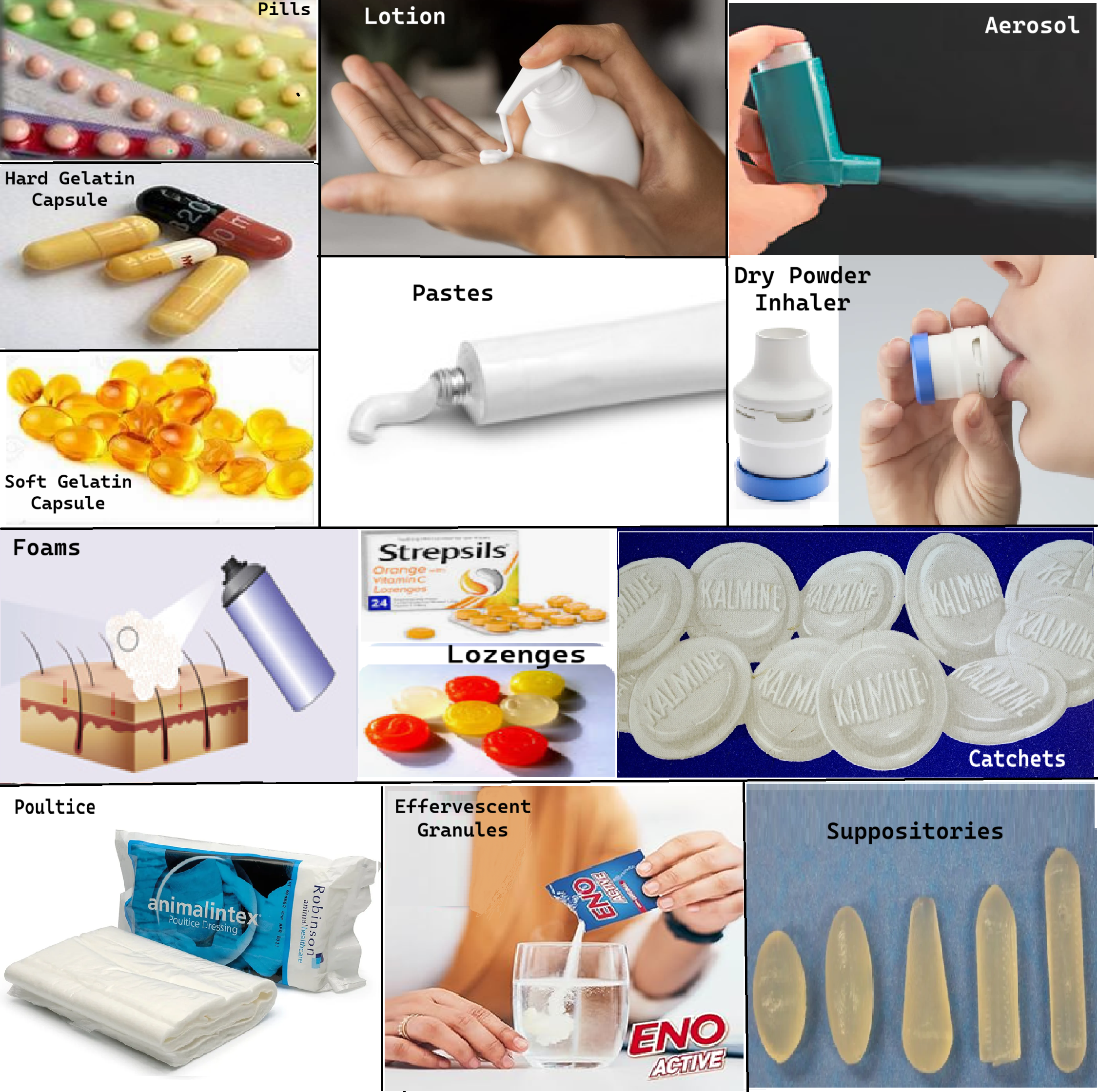
Capsules are solid dosage forms in which the API and excipients are enclosed within a soluble container or shell. The shells may be composed of two pieces, a body and a cap, or they may be composed of a single piece. Two-piece capsules are commonly referred to as hard-shell capsules, and one-piece capsules are often referred to as soft-shell capsules.
The soft gelatine shell is somewhat thicker than that of two-piece capsules and is plasticized by the addition of polyols such as glycerine, sorbitol, or other suitable material.
Pills
Pills are solid, single-unit oral dosage forms traditionally prepared by mixing active pharmaceutical ingredients (APIs) with suitable excipients to form a cohesive mass, which is then rolled, cut, and shaped into small spherical or ovoid units.
Inhalation Powders
Inhalation Powders, commonly known as dry powder in-halers (DPIs), consist of a mixture of API(s) and typically the carrier; and all formulation components exist in a finely divided solid state packaged in a suitable container-closure system. The dose is released from the packaging by a mechanism and is mobilized into a fine dispersion upon oral inhalation by the patient.
Aerosols
Aerosols are pressurized dosage forms that deliver medications as fine particles or droplets when the valve is activated.
They contain a drug dissolved or suspended in a suitable propellant and are dispensed as a mist, spray, foam, or semisolid depending on the formulation and type of valve used. Upon the active substance actuation of the valve system, the API is released as a plume of fine particles or droplets.
Creams
Creams are semisolid emulsion dosage forms. They often contain more than 20% water and volatiles and typically contain less than 50% hydrocarbons, waxes, or polyols as the vehicle for the API. Creams generally are intended for external application to the skin or to the mucous membranes. Creams have a relatively soft, spreadable consistency and can be formulated as either a water-in-oil emulsion (e.g., Cold Cream or Fatty Cream as in the European Pharmacopoeia) or as an oil-in-water emulsion (e.g., Betamethasone Valerate Cream).
Gels
Gel is a semi-solid dosage form consisting of a dispersion of small or large molecules in an aqueous or hydroalcoholic vehicle, forming a three-dimensional network that gives it a unique jelly-like consistency, Characterized by their smooth texture, ease of application, and ability to spread uniformly on the skin or mucosal surfaces.
Gels are commonly used for topical, ophthalmic, nasal, and oral applications, delivering drugs either for local action (such as anti-inflammatory, analgesic, or antimicrobial effects) or for systemic absorption in certain formulations.
A typical gel formulation includes active pharmaceutical ingredients, gelling agent, humectants (e.g., glycerin, propylene glycol), preservatives, pH modifiers, and purified water.
Pastes
Pastes are semisolid dosage forms that contain a high proportion of finely powdered solids mixed with a base. Because of their high solid content, pastes are thicker, stiffer, and more stable than ointments. They are usually applied to the skin to provide a protective coating, absorb secretions, and reduce irritation. Pastes stay in place for a longer time and are less greasy, making them suitable for conditions where a firm, protective, and non-migrating application is needed.
Foams
Medicated foams are emulsions containing a dispersed phase of gas bubbles in a liquid continuous phase containing the API. Medicated foams are packaged in pressurized containers or special dispensing devices and are intended for application to the skin or mucous membranes. The medicated foam is formed at the time of application. Surfactants are used to ensure the dispersion of the gas and the two phases.
Lozenges
Lozenges are solid oral dosage forms that are designed to dissolve or disintegrate slowly in the mouth. They contain one or more APIs that are slowly liberated from the flavoured and sweetened base. They are frequently intended to provide local action in the oral cavity or the throat, but also include those intended for systemic absorption after dissolution. The typical therapeutic categories of APIs delivered in lozenges are antiseptics, analgesics, decongestants, antitussives, and antibiotics. Molded lozenges are called cough drops or pastilles. Lozenges prepared by compression or by stamping or cutting from a uniform bed of paste sometimes are known as troches. Troches are often produced in a circular shape.
Cachets
Cachets are solid unit dosage forms that consist of a small, sealed container—traditionally made of rice paper or starch—designed to enclose a single dose of a medicinal substance. They were developed as an alternative to capsules, especially for drugs that possess an unpleasant taste, odor, or irritant nature. Cachets are usually flat and oval, and are filled with dry powders. Before swallowing, the cachet is typically moistened to soften the shell, making it easier to ingest. Once taken with water, the outer container rapidly disintegrates in the stomach, releasing the enclosed drug.
Tinctures
Tinctures are alcoholic or hydroalcoholic liquid preparations made by extracting active constituents from plant materials or dissolving chemical substances in alcohol. They typically contain 15–80% ethyl alcohol, which acts as both a solvent and preservative, giving the product good stability. Tinctures are potent preparations and are usually taken in small, measured doses such as drops. They are commonly prepared by maceration, percolation, or simple solution, and must be stored in tight, light-resistant containers to prevent alcohol loss. Overall, tinctures provide a stable, concentrated, and easily administered liquid dosage form.
Poultices
Poultices, also known as cataplasms, are soft, moist, semi-solid dosage forms intended for external application on the skin. They are typically prepared from natural or synthetic materials such as glycerin, kaolin, starch, herbal pastes, or other hydrophilic bases that can retain moisture and heat. The consistency of a poultice is thick, smooth, and paste-like, allowing it to adhere easily to the skin and remain in place when applied warm. These dosage forms are primarily used for their soothing, emollient, counter-irritant, or drawing actions, helping to reduce inflammation, relieve pain, soften tissues, or promote drainage of infected or congested areas.
They are usually applied on a cotton or linen backing and kept in contact with the affected area for a specific duration to enhance therapeutic effect.
Liniments
Liniments are liquid or semi-liquid topical dosage forms designed for external application to the skin with gentle rubbing or massage. They are typically solutions, emulsions, or alcoholic/oily preparations, giving them a thin, spreadable consistency that allows easy penetration into the skin. Depending on their base, liniments may be oil-based (for lubrication and massage), alcohol-based (for a cooling, counter-irritant effect), or soap-based (for enhanced cleansing and penetration).
Liniments are commonly used to relieve muscular pain, stiffness, sprains, arthritis discomfort, and neuralgia.
Lozenges
These are solid, flavoured, medicated dosage forms designed to dissolve slowly in the mouth, releasing the drug locally to the throat or oral cavity. They are usually disc-shaped or flat, with a smooth and firm consistency that allows gradual dissolution without chewing. Lozenges are commonly used for providing relief from sore throat, cough, mouth infections, or for delivering antiseptics, analgesics, demulcents, and sometimes vitamins. Their formulation typically contains a sugar base (such as sucrose and dextrose) or a sugar-free base (like sorbitol or mannitol), blended with binding agents, flavouring agents, colourants, and the active drug.
Lotion
A lotion is a liquid or semi-liquid topical dosage form designed for application on the skin or scalp to deliver therapeutic or protective agents. Lotions typically have a low to medium viscosity, making them easy to spread over large or hairy areas of the body. They may be aqueous, hydro-alcoholic, or oil-in-water emulsions.
Lotions are particularly useful for conditions where a non-greasy, easy-spreading preparation is preferred, such as in treating inflammation, dryness, infections, or irritation of the skin.
Eye and Ear Drops
Eye and ear drops are sterile, liquid dosage forms designed for direct instillation into the eyes or ears to deliver therapeutic agents locally. These preparations generally have a watery (aqueous) consistency, although some may be slightly viscous to increase contact time and improve drug absorption. Eye drops must be isotonic, sterile, and free from particulate matter to avoid irritation and ensure patient comfort, while ear drops primarily focus on local action and do not always require isotonicity.
These dosage forms provide a convenient, non-invasive route that allows rapid local action with minimal systemic side effects.
Suppositories
Suppositories are solid dosage forms intended for insertion into body cavities such as the rectum, vagina, or urethra, where they melt, soften, or dissolve to release the medicament and exert either local or systemic effects. They are generally formulated using bases like cocoa butter, glycerogelatin, or polyethylene glycol (PEG), each selected for its melting point, stability, and compatibility with the drug.
Granules
Granules are the dosage forms unusual means of administering drugs that possess an unpleasant taste. The drug is mixed with sugar, a flavouring agent and inert adjuncts, moistened to produce a coherent mass which is converted into granules by passing through sieves. The resultant small irregular particles ranging from 2 to 4 mm in diameter are often supplied in single dose sachets the contents of which are stirred in water before taking.
Effervescent Granules:
Effervescent granules are primarily composed of a mixture of citric acid, tartaric acid, and sodium bicarbonate. A medicament is usually incorporated, and sucrose or saccharin may be added as a sweetening agent. When the patient dissolves the prescribed dose in water, the acids react with the bicarbonate to produce carbonic acid, and the preparation is consumed during effervescence or immediately after it ceases. The resulting carbonated solution helps to mask the unpleasant taste of saline drugs administered in this form.